

Springs that stretch and spring back
Pull a rubber band and it gets longer. Let go and it returns to its first length. A material that does this is elastic. Springs, rulers and trampolines all use elasticity.
Hooke's law
- Hooke's law
- The extension of a spring is directly proportional to the force applied, as long as the elastic limit is not passed.
- force on the spring (newtons, N)
- spring constant (how stiff the spring is) (N/m)
- extension (new length minus original length) (metres, m)
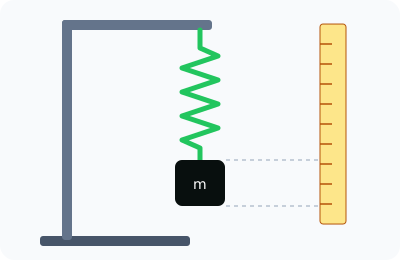
Tap the dots to see what each part is.
See it move
Try it yourself
Try itHang a mass on a spring
Change the mass and the stiffness of the spring. Watch the extension and the graph. Weight is with N/kg.
Worked exampleForce needed to stretch a spring
A spring has a spring constant of . What force stretches it by ?
- Write the formula.
- Change the extension to metres: .
- Put in the numbers.
- Calculate.
Answer: The force is 10 N.
Where Hooke's law stops working
- Small forcesExtension is proportional to force. The spring returns to its first length.
- Elastic limitThe most force the spring can take and still return to its first length.
- Too much forceThe spring is stretched past its limit and stays longer. Hooke's law no longer applies.
Elastic
- Returns to its first shape
- Spring, rubber band, steel ruler
Plastic
- Keeps its new shape
- Clay, a bent paper clip
| Spring | k (N/m) | Force for 0.1 m |
|---|---|---|
| Soft | 20 | 2 N |
| Medium | 50 | 5 N |
| Stiff | 100 | 10 N |
Add masses, measure extensions and find from the gradient of your graph.
Key terms
- Elasticity
- The ability of a material to return to its shape after a force is removed.
- Extension
- How much longer a spring becomes: new length minus original length.
- Spring constant
- The force needed per metre of extension, in N/m.
- Elastic limit
- The largest force after which the spring still returns to its first length.
Summary
- Elastic materials return to their shape when the force is removed.
- Hooke's law: while the elastic limit is not passed.
- A force–extension graph is a straight line through the origin; its gradient is .
- Past the elastic limit the spring is permanently stretched.